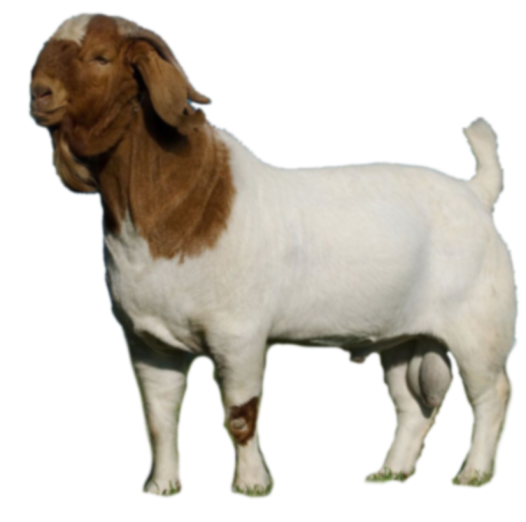
Boer Goat Growth & Weight
A well-fed Boer cross gains 120 to 200 grams per day and should reach about 20 kg by 3 months, 30 kg by 6 months and 40 kg by 9 months. If your goats are more than 15% below these figures, check for worms first, then feed quality.
राम्रोसँग खुवाइएको बोयर क्रस दैनिक १२०–२०० ग्राम बढ्छ। ३ महिनामा करिब २० किलो, ६ महिनामा ३० किलो र ९ महिनामा ४० किलो पुग्नुपर्छ।
Updated
Weight by age
| Age | Target weight | What should be happening |
|---|---|---|
| Birth | 3–4 kg | Standing and suckling within an hour |
| 1 month | 8–10 kg | On milk, starting to nibble fodder |
| 3 months | 18–25 kg | Weaning; eating fodder and concentrate |
| 6 months | 28–35 kg | Fastest growth phase; separate the males |
| 9 months | 35–45 kg | Approaching market weight |
| 12 months | 45–55 kg | Market weight reached; does can be bred |
Daily weight gain
| Category | Daily gain | Notes |
|---|---|---|
| Local goat (Khari) | 50–80 g | For comparison |
| Boer cross, average feed | 90–130 g | Common on Nepali farms |
| Boer cross, good feed | 150–200 g | Achievable with planned feeding |
| Boer cross, wormy or sick | 0–50 g | Or losing weight |
Daily gain is the single most useful number on a goat farm. Weigh a few animals on the same day each month, subtract, and divide by the number of days. If gain drops, something has changed — and you will know within weeks rather than at selling time.
How to check whether yours are on target
Pick five animals and mark them
Use the same five every month. Ear tags or paint marks are fine.
Weigh on the same date each month
Before morning feeding, so gut fill does not distort the figure.
Write it down
A notebook is enough. Date, animal, weight. Without records you are guessing.
Compare against the table above
Within 15% of target is fine. More than 15% below needs investigating.
If they are behind target
Work through these in order. Do not start by buying more feed — feeding a goat with a heavy worm burden mostly feeds the worms.
- Parasites. Check eyelid colour for anaemia and look at dung consistency. Worms are the most common cause of poor growth in Nepal.
- Water. A goat that cannot drink enough clean water will not eat enough. Check supply and cleanliness.
- Protein. Growing goats need more protein than mature ones. Fodder tree leaves and a concentrate mix supply it.
- Shed conditions. Wet bedding, poor ventilation and overcrowding all suppress growth and invite pneumonia.
- Disease. Any fever, cough, diarrhoea or lameness stops growth. Treat the illness before adjusting feed.
- Genetics. Last on the list, not first. Most poor growth is management, not breeding.
Mature size
A mature pure Boer buck can reach 90 to 130 kg and a doe 80 to 100 kg under excellent conditions. Crossbred animals on Nepali farms typically mature lower than this. Do not judge your animals against pure-Boer show weights.
Common questions
How much weight should a Boer goat gain per day?
How much should a 6-month-old Boer goat weigh?
At what age do Boer goats reach market weight?
Why are my Boer goats not growing?
Read next
How to Grow Big, Healthy Goats
The five things that actually decide how big your goats get, in the order they matter, plus how to find the problem when growth stalls.
Grow BiggerFeeding Plan for Growing Goats
How much to feed a goat by body weight, a concentrate mix from ingredients available in Nepal, and the fodder trees goats prefer.
HealthDeworming and Worm Control
Why worms are the biggest hidden cost on Nepali goat farms, how to check for them using eyelid colour, and how to deworm without breeding resistant worms.
Questions about your own goats?
We farm Boer goats in Chitwan and are happy to talk through your situation — which breeding suits your district, what stock costs, or how to fix a problem on your farm.