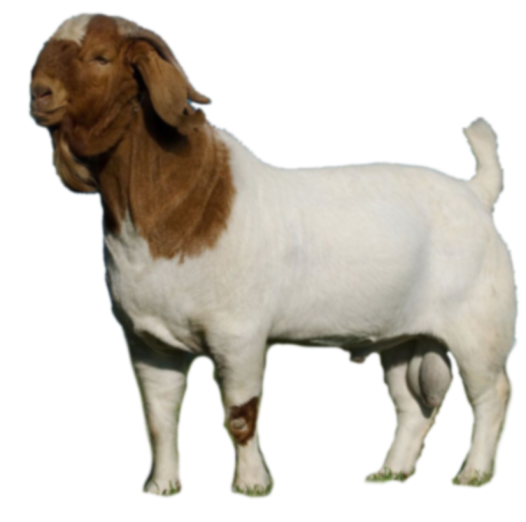
Boer Percentages Explained
The percentage is how much Boer blood an animal carries. Crossing a local doe with a pure Boer buck gives a 50% kid; crossing that daughter with a Boer buck again gives 75%, then 87%, then 93%. Higher percentages grow faster but need better feed and shelter — most Nepali commercial farms do best at 75% or 87%.
प्रतिशत भन्नाले बाख्रामा कति बोयर रक्त छ भन्ने बुझिन्छ। प्रतिशत बढ्दा वृद्धि छिटो हुन्छ तर राम्रो खोर र दानाको आवश्यकता पर्छ।
Updated
How each generation is produced
Every kid inherits half its genes from each parent. So each time you breed a crossbred daughter back to a pure Boer buck, the Boer content moves halfway towards 100%.
| Generation | Cross | Boer content |
|---|---|---|
| F1 | Local doe × pure Boer buck | 50% |
| F2 | F1 doe × pure Boer buck | 75% |
| F3 | F2 doe × pure Boer buck | 87.5% |
| F4 | F3 doe × pure Boer buck | 93.75% |
| Pure | Both parents pure Boer | 100% |
This is why one pure buck is such a powerful investment. He does not just improve his own kids — he improves every generation after them.
What each percentage gives you
75% Boer cross — the safe starting point
Grows far faster than a local goat while keeping most of the local hardiness. Handles heat, humidity, cold and ordinary grazing without complaint. This is the right choice for a first-time farmer, for hill districts, and for any farm where the shed and feed supply are still being sorted out.
87% Boer cross — the commercial sweet spot
Looks and grows very close to a pure Boer but retains useful local resistance. This is the grade most commercial meat farms settle on. It rewards a decent shed and reliable year-round fodder, and it is forgiving enough to survive a mistake.
93% Boer cross — for well-run farms
Functionally similar to a purebred for meat production. Grows fastest of the crosses, but has the least tolerance for poor feed, wet bedding and monsoon humidity. Only worth the extra money if your shed is dry and well ventilated and your feeding is planned for all twelve months.
100% pure Boer — for breeding, not for meat
The reason to buy a pure animal is genetics, not meat. A pure buck upgrades an entire herd. Buying pure animals to fatten and sell rarely makes financial sense in Nepal, because you pay a breeding-stock price for an animal you will sell at a meat price.
Choosing for your farm
| Your situation | Buy this | Why |
|---|---|---|
| First goats, learning as you go | 75% cross | Most forgiving of mistakes |
| Hill or high-hill district | 75% cross | Best cold and damp tolerance |
| Terai, commercial meat farm | 87% cross | Best balance of growth and hardiness |
| Good shed, planned feeding, maximum growth | 93% cross | Fastest gain, needs good management |
| You already have local does | One 100% pure buck | Upgrades every kid born from now on |
Common questions
What does 75% Boer goat mean?
Which Boer percentage is best for Nepal?
Is it worth buying a 100% pure Boer?
How many does can one Boer buck serve?
Read next
Boer Goats in Nepal
What a Boer goat is, why it grows twice as fast as local breeds, how it handles Nepal's climate, and how crossing works. Written in plain language for farmers.
PricesBoer Goat Price in Nepal
Current Boer goat prices in Nepal: NPR 900 to 2,500 per kg live weight depending on breeding percentage. Full rate table, what changes the price, and delivery costs.
Boer GoatsHow to Spot a Fake Boer Goat
Physical signs, records to demand and questions to ask so you are not sold a low-percentage or non-Boer goat at a pure-Boer price.
Boer GoatsBoer vs Khari Goat
A side-by-side comparison of Boer crosses and Nepal's local Khari goat — growth, hardiness, feed needs, cost and which one actually earns more.
Questions about your own goats?
We farm Boer goats in Chitwan and are happy to talk through your situation — which breeding suits your district, what stock costs, or how to fix a problem on your farm.