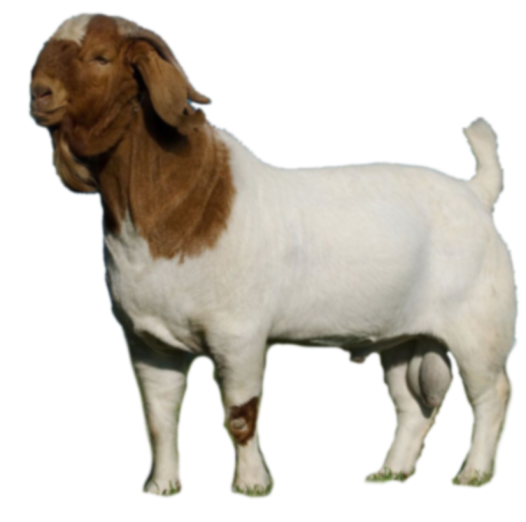
Boer Goats in Nepal
The Boer is a meat goat breed developed in South Africa. It gains weight roughly twice as fast as Nepal's local goats and produces more meat per animal. Most Nepali farmers do not buy pure Boers — they buy a pure Boer buck, cross it with local does, and raise the crossbred kids.
बोयर दक्षिण अफ्रिकाबाट आएको मासुका लागि पालिने बाख्राको जात हो। यो नेपाली स्थानीय बाख्रा भन्दा झन्डै दोब्बर छिटो बढ्छ।
Updated
Where the Boer comes from
The Boer was developed by farmers in South Africa in the early 1900s. The name comes from the Afrikaans word for farmer. Unlike most goat breeds, which were kept for milk or fibre, the Boer was bred from the start for one thing: meat. A century of selecting the fastest-growing, best-muscled animals produced a goat that puts on weight faster than almost any other breed.
Advanced Boer genetics reached Nepal around 2072 BS. Since then Boer crosses have spread across the country and become the most popular improved breed for commercial meat production.
How to recognise a Boer
- White body with a brown or red head, usually with a white stripe down the face.
- Long, wide, drooping ears that hang down beside the head.
- Heavy, muscular body — noticeably thicker through the shoulder and hindquarter than a local goat.
- Dark pigmented skin around the eyes, nose, udder and under the tail. This pigment protects against sunburn and is a sign of genuine Boer breeding.
- Roman nose — a slightly curved profile rather than a straight one.
Why farmers switch to Boer crosses
| Local goat (Khari) | Boer cross | |
|---|---|---|
| Daily weight gain | 50–80 g | 120–200 g |
| Weight at 3 months | 8–12 kg | 18–25 kg |
| Weight at 9 months | 18–22 kg | 35–45 kg |
| Dressing percentage | 40–45% | 45–50% |
| Twins per kidding | Sometimes | Commonly |
The important number is not the final weight but the time taken to reach it. A Boer cross reaches market weight in roughly half the time, so you buy feed for fewer months per kilogram of meat produced. That is where the profit comes from.
How crossing works in practice
Buying a whole herd of pure Boers is expensive and, in most of Nepal, unnecessary. The standard approach is to buy one pure Boer buck and cross him with the local does you already have. Every kid born is a 50% cross, and every one of them grows far faster than its mother did.
Start with local does
Khari or other local does are already adapted to your climate, feed and local diseases. That hardiness is worth keeping.
Buy one good pure Boer buck
A single buck can serve 25 to 30 does. This is the cheapest way to bring Boer genetics into a herd.
Raise the first-cross kids
These 50% kids reach market weight much faster than pure local kids. Sell the males, keep the best females.
Breed the best females back
Crossing those daughters to a Boer buck again lifts the next generation to about 75%, then 87%, and so on.
Do Boer goats survive in Nepal's climate?
Yes, but with attention. Boers evolved in the dry, semi-desert conditions of South Africa. Nepal's Terai is hot and very humid during the monsoon, which brings two real risks: pneumonia and internal parasites. Crossbred animals handle this far better than pure Boers because they inherit local resistance.
| Region | What works | Main thing to watch |
|---|---|---|
| Terai (Chitwan, Nawalparasi, Bara) | Up to 93% crosses do well with a good shed | Monsoon humidity — worms and pneumonia |
| Hills (Kaski, Tanahun, Palpa) | 75% and 87% crosses are the safest choice | Cold, damp winters; keep animals dry |
| High hills / mountains | 75% crosses only, with good winter shelter | Cold stress and limited winter fodder |
What Boer goats eat
The same grass, tree leaves and fodder as local goats — there is no special imported feed. The difference is quantity and quality. A fast-growing Boer cross needs more protein than a local goat to actually express its growth potential. Feed it like a local goat and it will grow like a local goat, and you will have paid extra for nothing.
More in this section
Boer Percentages Explained
What 75%, 87%, 93% and 100% Boer breeding actually mean, how each generation is produced, and which percentage suits your farm and budget.
Boer Goat Growth & Weight
Expected Boer goat weight by age, normal daily weight gain, and how to tell whether your goats are growing on target.
Boer vs Khari Goat
A side-by-side comparison of Boer crosses and Nepal's local Khari goat — growth, hardiness, feed needs, cost and which one actually earns more.
How to Spot a Fake Boer Goat
Physical signs, records to demand and questions to ask so you are not sold a low-percentage or non-Boer goat at a pure-Boer price.
Common questions
What is a Boer goat?
How much faster do Boer goats grow than local Nepali goats?
Should I buy pure Boer goats or crosses?
Can Boer goats survive in the hills of Nepal?
Do Boer goats need special feed?
Read next
Boer Percentages Explained
What 75%, 87%, 93% and 100% Boer breeding actually mean, how each generation is produced, and which percentage suits your farm and budget.
Boer GoatsBoer Goat Growth & Weight
Expected Boer goat weight by age, normal daily weight gain, and how to tell whether your goats are growing on target.
Boer GoatsBoer vs Khari Goat
A side-by-side comparison of Boer crosses and Nepal's local Khari goat — growth, hardiness, feed needs, cost and which one actually earns more.
PricesBoer Goat Price in Nepal
Current Boer goat prices in Nepal: NPR 900 to 2,500 per kg live weight depending on breeding percentage. Full rate table, what changes the price, and delivery costs.
Questions about your own goats?
We farm Boer goats in Chitwan and are happy to talk through your situation — which breeding suits your district, what stock costs, or how to fix a problem on your farm.