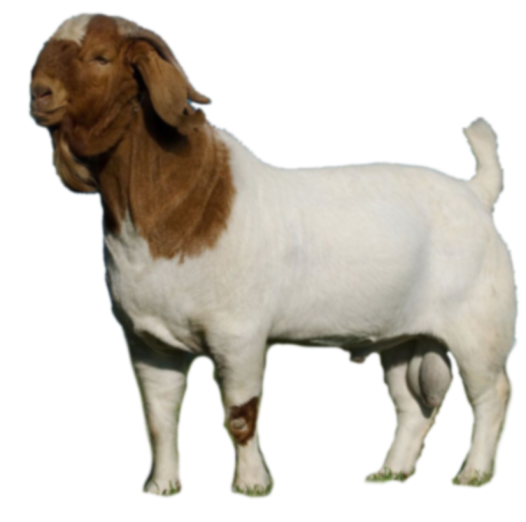
How to Spot a Fake Boer Goat
Check for dark pigmented skin around the eyes, nose and under the tail, long drooping ears, a Roman nose and heavy muscling. Then ask to see the buck the kid came from and the farm's records. Colour alone proves nothing — a white goat with a brown head is easy to fake.
आँखा, नाक र पुच्छर मुनिको कालो छाला, लामो झुण्डिएको कान र बलियो मासु जाँच्नुहोस्। रङ मात्र हेरेर विश्वास गर्नु हुँदैन।
Updated
As Boer prices rose, so did the number of animals sold as higher-percentage than they are. This costs farmers real money — you pay a 93% price for a 50% animal, then wonder why it grows slowly. Here is how to check.
Physical signs to check
| Check | Genuine Boer breeding | Warning sign |
|---|---|---|
| Skin pigment | Dark skin around eyes, muzzle, under the tail and on the udder | Pink or pale skin in these areas |
| Ears | Long, wide, hanging down flat beside the head | Short, upright or narrow ears |
| Head profile | Slightly curved Roman nose, broad muzzle | Straight, narrow, fine head |
| Muscling | Thick through shoulder, loin and hindquarter | Flat, narrow hindquarter |
| Legs | Short, strong, well-placed under a wide body | Long, thin legs; narrow chest |
| Colour | White body, brown or red head | Correct colour proves nothing on its own |
Records and questions
- Ask to see the buck the kid was sired by — on the same farm, on the day.
- Ask what percentage the mother was, and how the seller knows.
- Ask for the vaccination and deworming record with dates.
- Ask how many kids the doe had and whether she twinned.
- Ask whether you can visit the farm rather than meeting at a market.
- Ask for the seller's phone number and check they answer it later.
An honest seller answers all of these without hesitation, because they have the animals and the records to back it up. Vagueness, pressure to decide immediately, or refusal to let you see the parent stock are the real warning signs — more telling than any physical feature.
At the point of purchase
- See the animal weighed on a scale in front of you.
- Agree the percentage and rate per kg before weighing, not after.
- Check the mouth, eyes, dung and feet for signs of illness.
- Check the eyelid colour — pale means anaemia, usually from worms.
- Watch the animal walk. Lameness is easy to hide standing still.
- Get the agreed price, percentage and delivery date in writing, even if only a signed note.
Common questions
How can I tell if a Boer goat is genuine?
What percentage Boer am I actually buying?
Is a white goat with a brown head always a Boer?
Read next
Boer Percentages Explained
What 75%, 87%, 93% and 100% Boer breeding actually mean, how each generation is produced, and which percentage suits your farm and budget.
PricesBoer Goat Price in Nepal
Current Boer goat prices in Nepal: NPR 900 to 2,500 per kg live weight depending on breeding percentage. Full rate table, what changes the price, and delivery costs.
Boer GoatsBoer Goats in Nepal
What a Boer goat is, why it grows twice as fast as local breeds, how it handles Nepal's climate, and how crossing works. Written in plain language for farmers.
Questions about your own goats?
We farm Boer goats in Chitwan and are happy to talk through your situation — which breeding suits your district, what stock costs, or how to fix a problem on your farm.